Monday, June 25, 2007

If you ran the county, what would you buy for $400 million?

The Commissioners want to raise at least $400 million (by spending upwards of $700 million in sales taxes on bond payments over the next thirty years) to buy a new public Convention Center.

The $400 million is not an actual investment which the Commissioners expect to earn back, e.g. through rental revenue. It’s a straight-up expenditure. The “return” it’s supposed to produce is private-sector jobs and taxes, in hotels, restaurants, the Medical Mart, etc.

So: If you were going to raise and spend $400 million in public money to spur private economic activity in Cuyahoga County, would you buy a Convention Center?

Here are a few alternatives to consider:
  • One Convention Center @ $400 million, or
  • 400 megawatts of utility-scale wind generators (with no debt to pay off, so the power would be very cheap)
  • Full-ride tuition at Cleveland State for more than ten thousand county residents
  • 8,000 street miles of optical fiber at an average cost of $50,000 per mile (1,300 miles would cover the entire city of Cleveland)
  • Major weatherization and furnace replacement for 60,000 to 80,000 homes. (While you’re at it, you could probably throw in lead paint abatement.)

That’s just off the top of my head. What’s your $400 million idea?

Make a wish.

Monday, June 18, 2007

SB 117 and the city: Moving on

The end of local cable franchising is not quite law in Ohio, not yet. The Ohio Senate must accept the House’s changes to SB 117, or a conference committee must reconcile the two versions, and the Governor must sign the final product. But this will all happen in a matter of days. The argument is over, the deal has gone down. Time to move on.

I think there are two take-aways for Cleveland community leaders and citizens who actually give a crap about what will happen to the city’s ability to govern itself and survive through the next couple of decades.

Take-away one: Nobody in the Columbus power structure — including the people we send there to represent us in the General Assembly, and the people we’ve supported for statewide office with our votes — gives a rat’s tookus for that quaint old concept known as municipal home rule. Nobody. It just doesn’t matter to them, when weighed in the political scales against anything desired by an industry, a moderate-sized labor organization, or fifteen random guys on suburban barstools.

The reason is simple and self-evident: Voting to take away another piece of Ohio communities’ self-governing power has no political cost, even when it’s your own community. Oh, the mayor might make a speech, and city council might pass a resolution, and the local paper might even write an editorial calling on you (not by name) to preserve municipal prerogatives. You might be forced to explain to a few voters how deeply you believe in home rule and how agonizing it is to balance that deep belief with the other concerns you’re called upon to address. But in the end, you can safely cast your political lot with the check-writers — the police and fire unions, the gas drillers. the gun lobby, the phone company, the cable company, the phone company’s union — against your own community, knowing that nobody will remember at election time.

If Frank Jackson and Cleveland City Council members really want to preserve a shred of home rule for this city, some Democratic Representative from Cleveland must lose his or her primary election in 2008 for voting against it. Otherwise, stop whining.

Take-away two: “Our” cable company, headquartered in Connecticut, and “our” phone company, headquartered in Texas, have decided they’ll no longer accept a cooperative, accountable relationship with us to operate their networks over our municipal rights of way. The General Assembly has eliminated the necessity for them to do so. So Cleveland now loses its free institutional network and other bandwidth services, its right to ensure citywide deployment of fiber, its ability to negotiate support for community technology training (i.e. getting the networks to help pay for community programs that train new customers for them), etc.

If there was ever a good reason for Cleveland to hesitate to build our own community-owned, multi-user network infrastructure, that reason is now history.

This “City of Choice” needs affordable real broadband in every neighborhood, we need it in the next couple of years, and we need to stop pretending that “the private sector” is going to provide it.

The city’s real private sector — thousands of small and mid-size companies trying to make a buck in a global marketplace — needs robust connectivity like it needs paved streets. It’s time for this community to start paving our own Information Streets so that the whole community can use them, not just one or two mammoth Triple Play vendors who are never going to consider our future to be their problem.

The Mayor’s wireless initiative is a good first step, but it’s just a first step. I recommend Bob Frankston’s current commentary at MuniWireless for a good place to start a more strategic consideration of Cleveland’s new situation.

****

Above all, people who care about Cleveland must learn the lesson that these people — AT&T, Time Warner, Ohio politicians of both parties — are not our friends. Not that they’re our enemies, either. But it’s time to stop mistaking smiles, handshakes, writing the occasional charity check or showing up at the occasional fundraiser for friendship. They’ve just demonstrated exactly how much they care about this community. Let’s learn our lesson and move on.

Wednesday, May 23, 2007

SB 117: Breaking other people’s eggs for AT&T’s omelet

Q. What do these Ohio cities have in common?

Athens. Newark. Mansfield. Ashtabula. Brunswick. Portsmouth. New Philadelphia. Lorain. Elyria. Norwalk. Hudson. Medina. Marion. Wapakoneta. Lima. Defiance. Bryan. Van Wert. Oregon. Bowling Green. Ashland. Wooster. Carrollton. Piketon. Lorain. Amherst. Oberlin.

A. These are just a couple of dozen of the hundreds of Ohio municipalities that are about to lose their home rule authority to negotiate and oversee cable franchises, and get absolutely nothing of value in return.

The House Public Utilities Committee is holding its proponent hearing on Senate Bill 117 right about now. Much is being said about the wonders of the competitive video service AT&T is ready to deliver to lucky consumers, just as soon as we get rid of those pesky local franchises. The Communications Workers spokesman is telling everyone how this is the next step Ohio has to take to get a thousand new jobs and a 21st century network. (No, I’m not there but trust me, I’ve got it memorized.)

But no one is talking about exactly where these marvels are going to take place, or more important, where they aren’t.

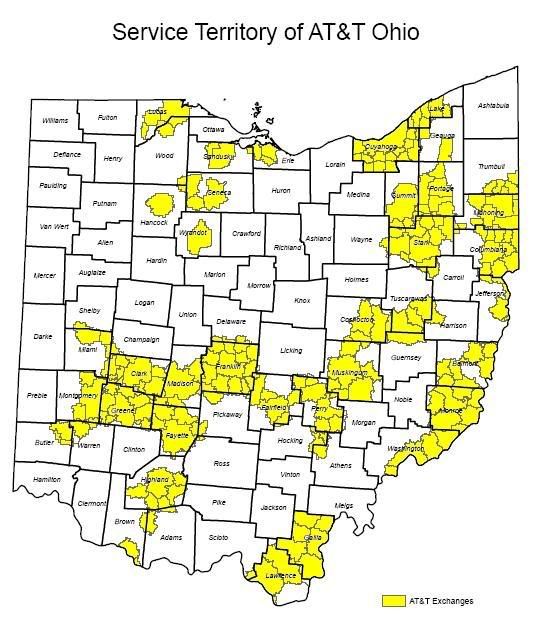
No one is explaining to Rep. Hottinger that SB 117 will bring Newark no closer to cable competition that it is today. No one is showing Rep. Distel and Rep. Barrett how the 21st century network will bypass Ashtabula, Lorain, Amherst and Norwalk. Unless Rep. Goyal or Rep. Stewart asks, no proponent witness is likely to mention Mansfield or Athens. It’s even less likely that any of today’s witnesses have brought along a map like this…

http://i88.photobucket.com/albums/k185/clevelanddiary/att_sa.jpg

… showing just how much of Ohio is eligible to benefit from a law designed solely to propel AT&T into the competitive broadband video business.

Yes, to make an omelet you have to break some eggs. But normally, if the eggs you’re cracking belong to me, I expect to get some breakfast.

It’s remarkable how free AT&T and SB 117’s other cooks are with other people’s eggs.

P.S. There’s a simple amendment to SB 117 that would fix the “other people’s eggs” problem. Just make the change from local franchising to a state “video service authorization” system effective only for communities where a new video service is actually entering the market.

No competition, no change. Fair enough?

Tuesday, May 8, 2007

SB 117: Where’s Verizon?

If all goes according to plan, an amended version of SB 117 will be voted out of the Ohio Senate Energy and Public Utilities Committee this afternoon. The vote to approve will be lopsided, possibly unanimous. There will be much praise for Senator Jeff Jacobson, the sponsor, for listening to the legitimate concerns of cities and public access providers and tweaking the bill in response. (Which is BS, but that’s another post… see Pho.) And there will be promises of wondrous benefits to Ohio consumers from the unleashing of “cable competition” throughout the state.

Of course the room will be packed with lobbyists. But there’s one important player who won’t be represented — or whose representative will be very, very quiet. And nobody will notice.

No one will ask: Where’s Verizon?

The single purpose of SB 117, Ohio’s “state video franchising reform” bill, is to clear the way for major telephone companies (”incumbent local exchange carriers”, or ILECs) to sell video and “triple play” services over fiber-enhanced versions of their existing infrastructures, without getting approval from the local governments that own the rights of way where those enhancements will take place. Versions of this bill have been moving through legislatures across the country. Early iterations, as in New Jersey and Texas, encountered serious lobbying opposition from the cable industry, which saw them correctly as an attempt to grab a big competitive edge in markets where phone companies are losing customers to cable VOIP. To blunt this inconvenient opposition, the telcos cut a deal last year in the Michigan legislature which was then imported to Ohio and other states: No more local video franchises for anyone! Thus, we got SB 117.

In this national march through the statehouses, state video franchise legislation has had two major backers: AT&T and Verizon. (In some states like Massachusetts, it’s known to opponents as “the Verizon bill”.) The nation’s two giant telcos are both banking on big-bandwidth converged services, video-VOIP-Internet, to recover and grow their shrinking telephone markets. And they’re both pushing “video competition” as their selling point to policy-makers.

In the national arena, Verizon is actually pretty far out in front of AT&T. Its “FiOS” product — optical fiber all the way to the premises — is simpler and faster than AT&T’s beefed-up DSL service (”U-Verse”), though more expensive to install. Verizon reported over 300,000 FiOS video subscribers at the end of the first quarter of 2007, compared to fewer than 20,000 for U-Verse.

But here in Ohio, Verizon’s contribution to the video franchising debate has been deathly silence.

Verizon hasn’t offered testimony on SB 117. Its name doesn’t appear with AT&T’s as a sponsor of www.ohiotvchoice.com. Its spokespeople have been completely absent from news coverage of the bill.

The whole SB 117 narrative is about AT&T. It’s all about AT&T competition, AT&T jobs, AT&T’s political clout. All the red Communications Workers t-shirts at the hearings are worn by AT&T workers.

Most important, the “buildout requirements” in SB 117 apply only to AT&T. That is, they apply only to telecommunications companies with more than a million access lines in Ohio. As you’ll see below, that’s one company.

Hmmm. Is AT&T the only phone company in Ohio? Or the only company that’s able to deploy modern network technology?

Are cable rates and “competition” a concern only to consumers who have AT&T phone service?

Will cities and villages lose their cable franchising authority under SB 117 only in AT&T’s service territory?

No. No. No. And noooo.

Yes, AT&T is Ohio’s biggest ILEC by far. In 2005, it served about 53% of the state’s 5.1 million reported access lines, and 51% of residential lines. It dominates all of the urban/suburban areas except Cincinnati, where Cincinnati Bell rules; and it has a pretty fair share of more rural markets as well.

But AT&T’s local exchanges still cover less than a third of the state. Here’s the map, courtesy of the PUCO:

http://i88.photobucket.com/albums/k185/clevelanddiary/att_sa.jpg

Who’s minding the phone in all those other counties and fractions of counties? There are more than forty other ILECs reporting to the PUCO. Some are tiny; fifteen of them served fewer than a thousand home access lines in 2005. The big guys are:
Verizon, with over 800,000 access lines in 80 counties;
Cincinnati Bell, with almost 700,000 access lines in six counties;
Embarq (fm Sprint/United), with about 550,000 access lines in 45 counties;
Windstream Western Reserve, with 170,000 access lines; and
Windstream Ohio (fm Alltel), with 120,000.

With the exception of Verizon, these are “second tier” players in the national telecom pecking order. But Verizon, with annual revenue in excess of $80 billion, is definitely first-tier.

Unfortunately, in Verizon’s pecking order, Ohio appears to be very near the bottom.

I've written before about Verizon’s reported desire to sell off its Ohio access lines, as it recently did with its operations in Maine, New Hampshire and Vermont. Given this desire, it’s not surprising that this state is not to be found in Verizon’s announced plans for FiOS deployment. In fact, Verizon only got around to making regular ADSL Internet service available to most of the communities in its Ohio territory five months ago — and only because it was required to by PUCO rules for “alternative regulation” of its basic phone service.

I recommend that you scroll down to the bottom of that last link and take a look at some of the Verizon communities that didn’t have normal ADSL access six months ago. Brunswick. Wadsworth. Oberlin. New Philadelphia. Norwalk. Portsmouth.

So what do you think are their chances of getting “cable competition”, via Verizon fiber to the premises, if SB 117 becomes law and Ohio gets state video franchising?

If you said “slim to none”, go to the head of the class. But under SB 117, all those cities are going to lose their cable franchising authority, just like those in AT&T territory, just like every other municipality in Ohio. And all their Senators and Representatives are being told that their voters will get “cable competition” in return.

It’s a lie.

Take another look at that map of Verizon’s Ohio service territory. Very few if any of the communities and consumers in that blue territory are going to get what they’re being promised by the sponsors of SB 117. No fiber to their homes. No video competition. No new broadband access. No jobs. Not… gonna… happen.

No wonder Verizon is keeping its head down and its mouth shut.

Any halfway responsible Senator or Representative who represents Verizon households, and who’s thinking about voting for SB 117, has a duty to make a simple phone call to the president of Verizon North, Todd Colquitt. (He also happens to be chairman of the board of the Ohio Telecom Association, which is pushing SB 117 — I’m sure they can provide his phone number). The phone call should consist of a single question: “Mr. Colquitt, if SB 117 becomes law, when can households in my district expect to have Verizon FiOS video service available?”

Saturday, May 5, 2007

The Chainlink Towpath

I thought you all might like a peek at the newly opened section of the Towpath Trail running through Stripmall Steelyard Commons. Click on the picture for a short slideshow…
 

The pictures were taken walking south from the rear of Home Depot to the rear of Target. As you can see, this is basically a long, narrow chainlink tunnel with the Mittal railroad yard on one side and, um, the back of a brand new strip mall on the other side. So lucky Towpath visitors can now glimpse Cleveland’s recent industrial past juxtaposedwith the symbols of our postindustrial future — prefab architecture, loading docks, dumpsters, the whole exciting World Class Retail package.

(Soon, I’m sure, the view through the chainlink will include 21st-century Clevelanders grabbing a smoke on their break and watching other 21st-century Clevelanders root through the dumpsters.)

It’s hard not to admire such a compelling representation of Cleveland’s modern economic history. And though the new stretch of Stripmall Steelyard Towpath may seem isolated and constricted — maybe even claustrophobic — it isn’t really that unfriendly; the eight-foot fences aren’t topped with razorwire. You can get over that sucker if you really need to.

But it sure seems a long way from the canal.

Update 5/7:  There’s been some debate about this post in comments at BFD.  My friend Laura says I’m being a curmudgeon and wonders where I buy my underwear.


If you’re unfamiliar with Stripmall Steelyard Commons, here’s a recent panorama.  Here’s a closer view with the mills behind it. And here’s one of the Towpath tunnels that Adam and Phil were talking about.

Friday, February 23, 2007

The Markos vs. the Menace

I’m not a Kos reader, so I didn’t know The Markos had posted this trash job on my Congressman till I read about it at MaxSpeak. It’s eleven hours old and there are already a thousand twelve hundred comments, so, you know, why bother? — whatever I’m gonna say is already in there somewhere.

But I would like to point out to whoever wanders by here that Kucinich’s’ so-called “urban 58 percent Kerry district” (the Ohio 10th CD), where I live, was held by a Gingrich Republican for two terms before Dennis ousted him in 1996, and that three-fourths of the precincts in this district are in the suburbs, not the city of Cleveland. Running for his sixth term last year, Dennis won 66% of the vote, 616 out of 641 precincts, and every single city, village and township in that mostly suburban district.

The western 25% of the 10th CD is the same as the 16th Ohio House District, which had a Republican state rep until Jennifer Brady squeaked out a 51% win this November. The 16th HD consists of five upper-middle-class suburbs, of which three have Republican mayors. Kucinich carried all five of those communities in November, winning 58% of their votes and 114 of their 138 precincts. (P.S. The 16th HD went for Bush over Kerry 53%-47%.)

I’m not claiming Dennis has a broad national or even statewide appeal; see the quote from Max below. But the idea that he’s just a city lefty whose message automatically alienates middle-class, suburban swing voters is refuted by the electoral evidence.

Not that I think The Markos gives a shit about evidence.

Also I would just like to mention that anyone who cites this book as evidence of anything needs to get off the freaking airplane and visit an actual city. Dennis screwed up his mayoralty in many ways, but refusing to “negotiate” Ralph Perk’s debts with Cleveland Trust by trading off Muny Light to CEI was not one of them. He preserved the asset, he got an income tax increase passed, and he handed both successes off to Voinovich who used them to become Mr. Solvency. Cleveland residents (and many suburbanites) know this, and have voted accordingly for the last twenty years.

Otherwise, I think Max’s response to Kos is about right. Yes, even this part:
Hear me now and believe me later: mockery of Dennis Kucinich is founded on fear of progressive politics, either from enemies on the right, or those who feel it threatens electoral viability and professional interests on the left.

And it’s true. Progressive ideas do threaten electoral viability for Democrats. This is a feature, not a bug. We want to threaten the viability of business as usual, whether in Iraq or in the homeland, because business as usual sucks. There are better and worse ways to do this. DK is acting the good Democrat, participating in the primaries. Wherever you are heading, he has already been there.

Wednesday, September 20, 2006

What will the casino initiative do for Cleveland students?

Not much, as far as I can see.

With Frank Jackson and other local political leaders jumping on board the so-called Learn and Earn ballot issue — the Constitutional establishment of a couple of big downtown slot machine parlors controlled by Al Ratner and Jeff Jacobs, throwing off money to a Board of Regents scholarship fund and to local governments — it seems wise to ask if this is actually a serious tool for increasing the number of Cleveland kids going to college.

Here’s how the proposed amendment describes its tuition assistance program:
Eligibility criteria for such scholarships and grants, and the amounts, shall be established solely by the Ohio Board of Regents. Such scholarships and grants shall include only the following:

(A) Individual learn and earn scholarship accounts for current and future students who, prior to enrolling in college, take core and advanced academic courses, participate in college readiness programs, assessment, and testing at any accredited public or non-public high school in this state, and contribute to public life through voluntary civic activity, and who attend any public or independent not-for-profit institution of higher education authorized by the Ohio Board of Regents and that has its principal office within this state.

(B) For the first twelve such high school graduating classes, uniform tuition grants, in an amount not to exceed the average undergraduate tuition charged by Ohio public universities, shall be awarded to the top five percent of students at each accredited public and non-public high school who attend any public or independent not-for- profit institution of higher education authorized by the Ohio Board of Regents and that has its principal office within this state. Such tuition grants shall be based solely on academic merit.
So, we have heavy tuition subsidies at Ohio colleges for the academic top 5% of each school’s graduates, classes of 2009 through 2020 only, who go to those colleges. Then, from what’s left of the 30% of casino proceeds going to the Regents — which the Learn and Earn backers say will be about $850 million a year — each Ohio K-12 schoolkid gets a “Learn and Earn account” with a deposit for each year the kid completes a curriculum specified by the Regents. When the kid graduates, he/she gets to use whatever he/she has accumulated to help pay tuition at an Ohio college.

Neither the “top 5%” scholarships nor the account deposits are tied to financial need. The top 5% of graduates of Hathaway Brown and University School who decide to attend Ohio schools will get the same dollar subsidy as the top 5% of Cleveland Public School graduates. And all two million kids in Ohio K-12 schools, public and private, will get the same annual account contributions if they complete the Regents’ requirements… no need-based`targeting permitted. (If anything, the targeting is to middle and upper-middle income kids who are more likely to be on the college track.)

So… what will this do to help Cleveland kids go to college?

While exact numbers are not easily available, a liberal estimate of Cleveland residents now graduating from public and private high schools is 3,500 a year. If 60% of these kids go to college, and 90% of them attend Ohio institutions, that’s a total of 1,900 eligible for Learn and Earn assistance of some kind, starting with the class of 2009.

The top 5% of this group would include fewer than 100 Cleveland graduates each year. That’s the top 5% of Ohio-college-bound graduates in each CMSD school building — the top 5% from Arts, the top 5% from Rhodes, the top 5% from East, from Glenville, from Max Hayes, etc. — plus the Cleveland kids (if any) who make it into that top college-bound 5% at St. Ed’s, Ignatius, Magnificat, St. Joseph’s, et al.

It will work out to one, or two, or three, or five kids at most from each high school — the kids nearest the top of their classes, many of whom will already be in line for scholarships from other sources.

Other than this very thin upper academic crust, how much help will Learn and Earn provide to other graduates trying to finance college? Well, this is all very iffy because the proposed amendment leaves so much up to the Regents. But here’s a way to estimate it:

For each year from 2009 on, take the proponents’ own estimate of $852 million a year going into the L&E fund by 2012. Assume we reach this amount by steady increments in the first four years (2009-2012), and remain there in subsequent years, adjusted for inflation. Assume that the current average tuition at state-run colleges rises from $8,000 today to $8,500 by 2009, and continues to rise only at the rate of inflation, i.e. remains stable in 2009 dollars. Assume that there continue to be two milllion Ohio kids in grades K-12, that one out of thirteen (154,000) graduate annually, that the top 5% for L&E’s purposes is thus 7,700, and that about half of all graduates will actually use their L&E accounts by attending Ohio colleges (which is about right based on current numbers from the Regents).

Then we get this formula, for, e.g., 2012:

$852 million - $262 million in “top 5%” subsidies = $590 million, divided by one million qualifying K-12 students = $590 available for deposit into each student’s L&E account in 2012.

From a spreadsheet based on this formula, here are the amounts I calculate that students in the first ten graduating classes could hope to “save up” in L&E scholarship money by the time they need it:


Remember, the four year tuition cost at Cleveland State or KSU is already over $30,000. So if I’m right, by the tenth year after the casinos open, an Ohio graduate heading for a state university could hope to cover less than one-sixth of tuition and fees with Learn and Earn money. In earlier years — for kids now in grades six through nine, for example — the impact of Learn and Earn on college affordability would be, well, negligible.

So for Cleveland, the big educational payoff of Learn and Earn would come down to fewer than twelve hundred significant scholarships to Ohio colleges between now and 2020, along with “college accounts” for other students that would be very little help to at least the next ten graduating high school classes.

Anyway, that’s how it looks to me. I await better information from anyone who can provide it.

Sunday, January 15, 2006

WSJ: Boardroom profiteering on 9/11 stock slump

Amazing how many tales are hidden behind that Wall St. Journal paywall. A couple of weeks ago I wrote about the apparent fact, covered only in the Journal, that Verizon is trying to sell off its entire phone business in Ohio and three other Midwest states. Today we learn this (WSJ story as quoted by The Big Picture):
On Sept. 21, 2001, rescuers dug through the smoldering remains of the World Trade Center. Across town, families buried two firefighters found a week earlier. At Fort Drum, on the edge of New York’s Adirondacks, soldiers readied for deployment halfway across the world.

Boards of directors of scores of American companies were also busy that day. They handed out millions of bargain-priced stock options to their top executives.

The terrorist attack shut the U.S. stock market for days. When it reopened Sept. 17, stocks skidded more than 14% over five days, in the worst full week for the Dow Jones Industrial Average since Germany invaded France in May 1940. But for recipients of options, the lower their company’s stock price when options are awarded the better, since the options grant a right to buy shares at that price for years to come. The grants set recipients up for millions of dollars in profit if the shares recovered.

A Wall Street Journal analysis shows how some companies rushed, amid the post-9/11 stock-market decline, to give executives especially valuable options. A review of Standard & Poor’s ExecuComp data for 1,800 leading companies indicates that from Sept. 17, 2001, through the end of the month, 511 top executives at 186 of these companies got stock-option grants. The number who received grants was 2.6 times as many as in the same stretch of September in 2000, and more than twice as many as in the like period in any other year between 1999 and 2003.

Ninety-one companies that didn’t regularly grant stock options in September did so in the first two weeks of trading after the terror attack. Their grants were concentrated around Sept. 21, when the market reached its post-attack low.
I urge you to read the whole Big Picture post.

Please note, this is not the old conspiracy-theory tale of insider trading before the September 11 attacks. No, this is the WSJ documenting another kind of conspiracy — a concerted rush by some of the country’s richest, most powerful “leaders” to make as much money as possible from the ruined lives around them. As Big Picture notes:
What makes this so pathetic is that corporate executives could have stepped up AND BOUGHT STOCKS IN THE OPEN MARKET if they believed they were so cheap. It would have been reassuring to a nation to see the leaders of industry voting with their own dollars. It might have made the subsequent economic slow down and period of tense aftermath less painful.

Instead, these weasels decided to loot the treasury at the first opportunity. America was smouldering, the WTC lay in ruins, and this group of classless pigs decided it was time to pocket some cash. (Heads-up from MaxSpeak.)

Update: More details at The Raw Story including this WSJ excerpt (emphasis added by me):
The 91 companies included such corporate icons as Home Depot Inc., Black & Decker Corp. and United Health Group Inc. It included two companies directly touched by the tragedy. Merrill Lynch & Co., across the street from the Twin Towers, lost three employees. On Sept. 24, Merrill granted its president options to buy more than 750,000 shares, at a price 15% below the pre-attack level. At Teradyne Inc. in Boston, an employee delayed a business trip until Sept. 11 to attend a son’s soccer game and died on American Flight 11. Teradyne that month gave its CEO more than 600,000 options at a price enabling him to buy stock at 24% below its pre-attack level.